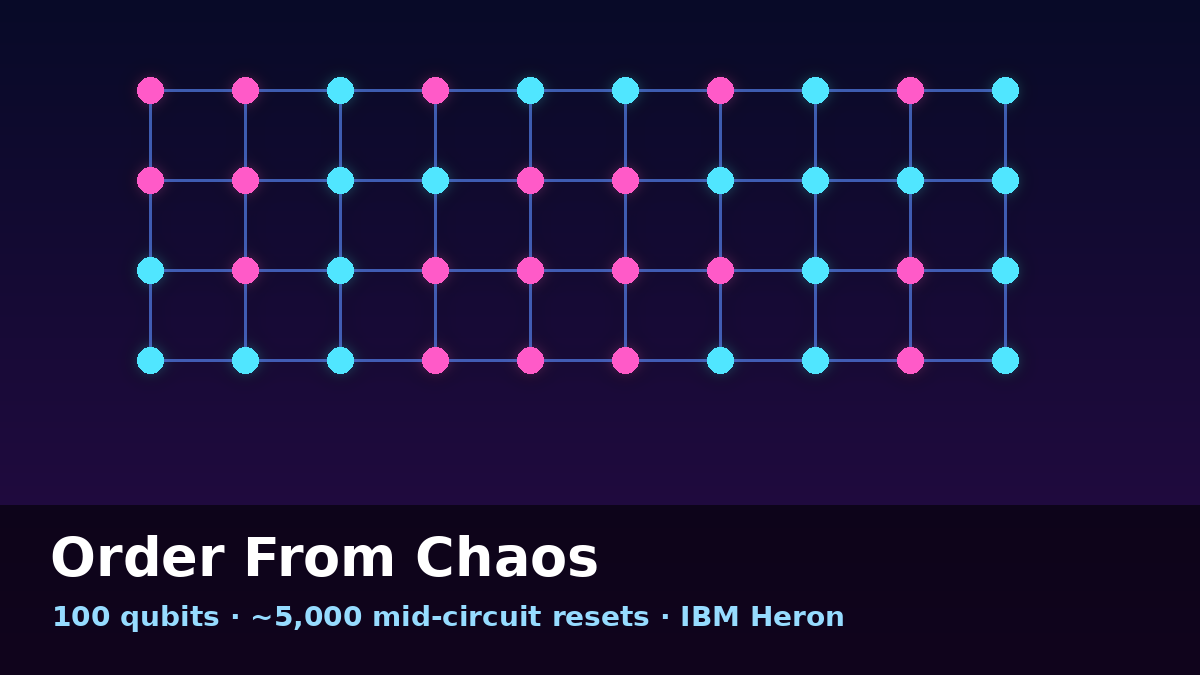
In a study published in Nature Physics in October 2026, researchers from Rutgers University, IBM and several collaborating institutions showed that a quantum computer can watch what is happening inside itself and react while it is still running. Using a chain of up to 100 qubits on a 156-qubit IBM Quantum Heron processor, the team performed nearly 5,000 two-qubit operations alongside nearly 5,000 mid-circuit checks and resets, steering a deliberately chaotic quantum system back into a controlled state. According to the researchers, it is the largest successful demonstration of this approach to date. Here’s what the experiment did, why “real-time feedback” matters, and what it means for the road to fault-tolerant quantum computing.
The Experiment: Chaos Versus Control
The researchers programmed the processor to alternate between two competing tasks. The first acted as a scrambler, mixing information among neighboring qubits and spreading chaos through the system, much like repeatedly shuffling a deck of cards. The second acted as a controller: the machine measured individual qubits mid-calculation and reset them when needed, nudging the system toward a simple, orderly state chosen in advance.
By tuning how often each task ran, the team could see which one would win. When scrambling occurred more than half the time, chaos prevailed. When checking and resetting dominated, the qubits could be guided to the target state. At roughly a 50-50 split, a tiny change tipped the entire system from one behavior to the other, a phase transition comparable to water freezing into ice. As Rutgers co-first author Haining Pan put it, “The agreement between the experiment and the theory showed that this was not an accidental feature of a small circuit. It was collective behavior emerging across the quantum system.”
Why Real-Time Feedback Matters
Qubits are fragile. Heat, stray electromagnetic signals, imperfect control pulses and hardware flaws all corrupt quantum states, and unlike ordinary data, quantum information cannot simply be copied for backup. A fault-tolerant quantum computer, one that keeps computing correctly even while its individual qubits make small mistakes, must detect and fix errors continuously without destroying the information it is protecting. No one has built such a machine yet.
“To build a fault-tolerant quantum computer, we have to make these checks and corrections not just once or twice, but a huge number of times during a calculation,” said Jedediah Pixley, a Rutgers professor and senior author. IBM’s Maika Takita, principal research scientist for quantum error correction and dynamic circuits, added that “present-day hardware can coordinate quantum operations, measurements and resets thousands of times across a large system.”
The key capabilities demonstrated include:
- Mid-circuit measurement: Reading individual qubits while the rest of the processor keeps operating.
- Conditional reset and feedback: Acting on those measurement results in real time, the same loop error-correction codes depend on.
- Scale: Up to 100 qubits, well beyond the roughly two dozen the team could simulate on conventional computers, with results closely matching theoretical predictions.
- Clearer behavior at larger sizes: The chaos-to-control transition became more sharply defined as the system grew, a sign of genuine collective behavior.
The Bigger Picture
This is not an error-corrected computation in itself; it is a demonstration of the machinery that error correction requires, running at a scale that classical simulation cannot easily verify. It also lands amid a busy stretch for quantum error correction research, as vendors increasingly focus on logical qubits, decoders and the classical control systems that must keep pace with quantum hardware.
For IT and infrastructure professionals, the takeaway is that the bottleneck in quantum computing is shifting from simply adding qubits to orchestrating them: fast classical control, low-latency feedback and tight integration between quantum processors and conventional compute. Those are systems-engineering problems that look a lot more like datacenter work than pure physics.
Looking Ahead
The study confirms a theoretical prediction that a sharply defined transition between chaos and control survives in real quantum hardware, and it shows that today’s processors can sustain thousands of measure-and-reset cycles across a large system. Researchers from the City College of New York, the CUNY Graduate Center, Iowa State University, Ames National Laboratory, Pennsylvania State University and Louisiana State University also contributed to the work.
Fault-tolerant quantum computing is still ahead of us, but each demonstration like this one narrows the gap. As Pixley summarized, “This experiment is a landmark on that road. It says, ‘OK, we’ve taken another important step to get there.’”
Sources:
- Nature Physics, “Order from chaos with adaptive circuits on quantum hardware,” October 2026
- Rutgers University via Phys.org, October 12, 2026
- IBM Research publication listing, 2026
- arXiv preprint 2509.18259