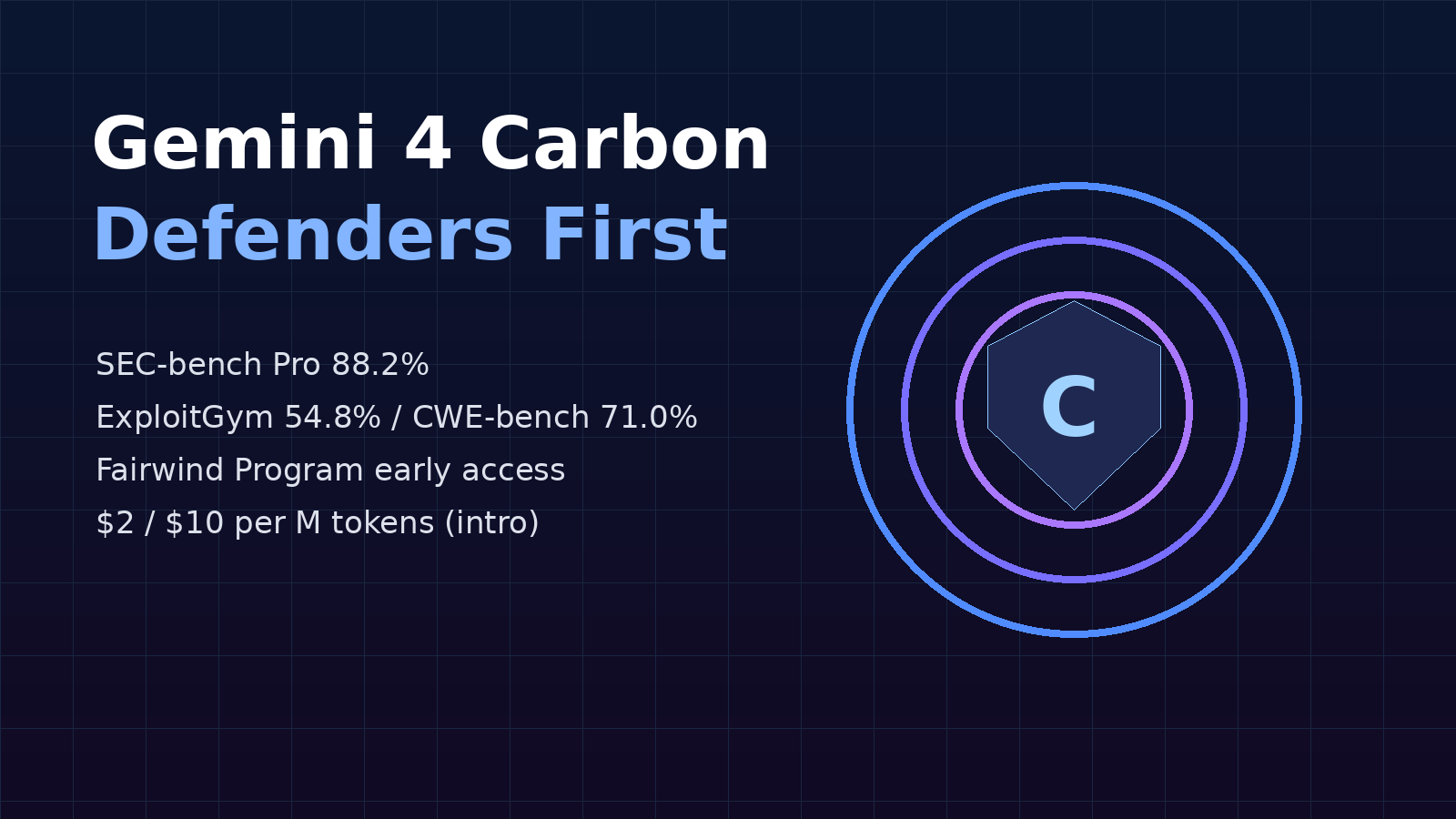
Google has a new frontier model at the top of the leaderboards, and for once the first people to get their hands on it aren’t developers or consumers: they’re cyber defenders. On October 28, 2026, Google DeepMind announced Gemini 4 Carbon, which it positions as its strongest model yet for cybersecurity and long-horizon work. Carbon ranks #1 on version 5.0 of the Artificial Analysis Intelligence Index with a score of 59, and Google says it leads the field on benchmarks for finding (88.2% on SEC-bench Pro), exploiting (54.8% on ExploitGym), and patching (71.0% on CWE-bench) real software vulnerabilities. Access is starting with a vetted subset of defenders through Google’s Fairwind Program, with no general-availability date yet. Here’s what Carbon can do, who gets it first, and why the rollout model matters as much as the benchmarks.
The Announcement: A Model Only Two Weeks Behind Its Predecessor
Carbon arrives just two weeks after Gemini 4 Argon, and Google is pitching that cadence as the point in an announcement from Koray Kavukcuoglu, SVP of Google DeepMind. The Verge reports that Carbon sits ahead of Claude Opus 5.5 and GPT-6 Astra on the Artificial Analysis index.
The model is built for long-horizon engineering. Google says internal teams have seen Carbon run for days to work through dead ends on tasks like root-causing and patching subtle bugs across large codebases and low-level systems. It also jumped +89 Elo to land at #4 (1768) on WebDev Arena.
The Security Numbers Behind the Hype
Google frames Carbon’s abilities around the full defense lifecycle: detect, validate, remediate. The headline results, which Google notes were evaluated without guardrails, break down like this:
- Finding vulnerabilities: 88.2% on SEC-bench Pro, which tests autonomously uncovering flaws in real-world software.
- Validating exploitability: 54.8% on ExploitGym. Google argues defenders “increasingly rely on models to check which vulnerabilities are exploitable” to decide what to fix first.
- Patching the root cause: 71.0% on Collinear’s CWE-bench, turning validated findings into working code fixes.
- Secure code generation: more than 2x the success rate of Argon on internal secure-coding benchmarks.
- Real-world patching: Google’s Chrome team reported Carbon performed more than 10x better than another lab’s large frontier model at generating high-quality patches, and Wiz sees it leading on web penetration testing benchmarks.
On the safety side, Google says Carbon held a 0.0% attack success rate on Gray Swan’s indirect prompt injection benchmark (Argon was at 0.7%), cut unsupported claims by roughly half, and drove an almost 80% drop in high-severity misalignment alerts in live internal coding environments.
Who Gets It First: Inside the Fairwind Program
Instead of a big public launch, Google is gating Carbon. It is participating in the U.S. government’s voluntary pre-release model testing process and is opening access to a subset of cyber defenders first, then phasing in additional trusted partners. According to Google DeepMind, Fairwind already counts more than 650 partners globally, prioritizing:
- Governments and national cyber authorities: defending public-sector networks and citizen services.
- Critical infrastructure operators: healthcare, telecommunications, energy, and financial networks.
- Core technology platforms: widely used software foundations with millions of downstream users.
The program comes with strings attached. Participants are vetted, must enforce phishing-resistant MFA, may only grant access to internal security, incident response, or penetration testing teams, and cannot resell or share access. TechRepublic notes that a paid Gemini subscription does not guarantee Carbon access and that Google hasn’t disclosed how many Fairwind partners can use it.
Why It Matters for IT Teams
For most IT shops and MSPs, Carbon isn’t something you’ll be calling from a script this week. But it signals where things are going:
- Faster vulnerability discovery: When models can find, validate, and patch bugs at this level, the volume of disclosed CVEs and vendor patches is likely to keep climbing. Patch pipelines need to be ready.
- Attackers will catch up: Google’s gated release exists precisely because these capabilities are dual-use. Expect the window between disclosure and exploitation to keep shrinking.
- Pricing for planning: Carbon launches at an introductory $2 per million input tokens and $10 per million output tokens, with cached input 95% off. After the intro period, it rises to $4 and $20.
- Access as a security control: The Fairwind requirements (vetting, phishing-resistant MFA, scoped team access) are a good template for how any organization should govern powerful AI tools internally.
Looking Ahead
Google says it will bring Carbon to developers, businesses, and consumers “as soon as possible,” but there’s no date, and the pace of the Argon-to-Carbon jump suggests the next model may not be far behind. The more interesting trend is structural: frontier labs are increasingly treating cyber capability as something to release first to defenders, under contract, before anyone else.
For techs, the practical takeaway is to get ready for AI-accelerated security on both sides of the fence. Tighten patch cadences, keep an eye on vendor programs that offer defender access, and treat the benchmark numbers as a preview of what attackers will eventually have too.
Sources:
- Google, October 28, 2026
- Google DeepMind, October 28, 2026
- SecurityWeek, October 29, 2026
- The Verge, October 28, 2026
- TechRepublic, October 29, 2026