
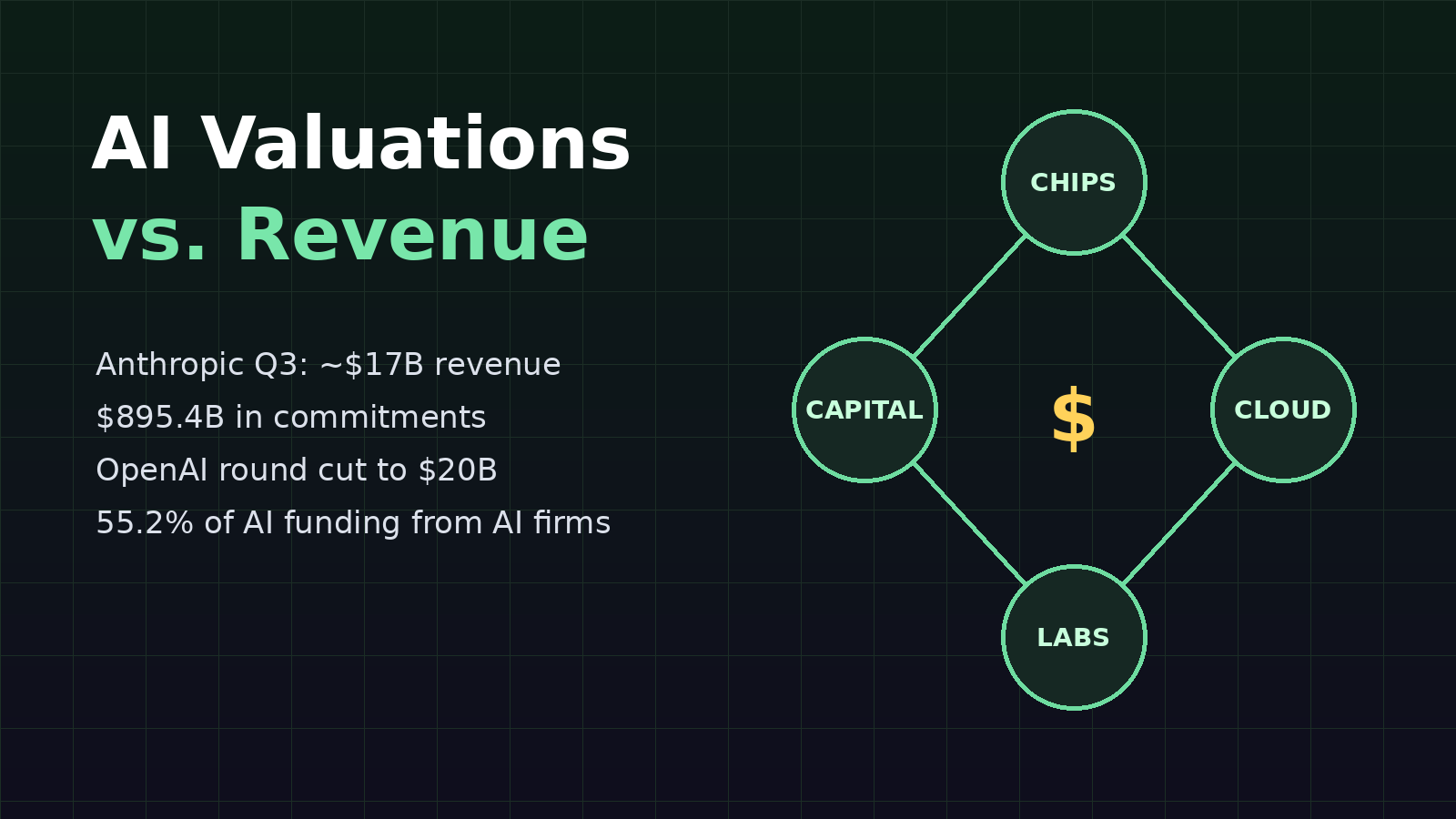
Is AI a bubble? It’s the question hanging over every IT budget meeting this fall, and the last week delivered some of the clearest data yet. On November 2, 2026, Anthropic filed an amended IPO prospectus showing roughly $17 billion in third-quarter revenue, up about 1,127% year over year, alongside a $23.29 billion quarterly net loss and about $895.4 billion in purchase and lease commitments. Two days earlier, CNBC confirmed that OpenAI had trimmed its latest funding target from about $30 billion to up to $20 billion. And a Bank for International Settlements study found that 55.2% of the money flowing into AI firms comes from other AI firms. None of that proves a bubble, and none of it rules one out. Here’s what the numbers actually say about valuations, revenue, and the circular money underneath.
The Revenue Is Real, and Growing Fast
Start with the part bulls point to. According to the amended S-1, Anthropic generated $33.24 billion in revenue in the nine months ended September 30, up roughly 1,200% from a year earlier. Fortune reports about $131.8 billion in cash and short-term investments at quarter end and $6.6 billion in cash generated from operations over nine months. Theory Ventures’ Tomasz Tunguz told Fortune the implied gross margin was still a healthy 85%.
That’s not the profile of a company with no customers. Epoch AI’s Campbell Hutcheson made the bull case to Fortune: paying a premium for compute can be a rational bet when growth is this strong and margins remain high.
The Valuation Math Is Demanding
The skeptics’ case is about price, not demand. A few data points worth knowing:
- Growth is decelerating: CNBC reports quarter-over-quarter revenue growth slowed to about 47% in Q3, down from 144% in Q2 and 132% in Q1.
- Compute costs are climbing faster: Fortune reports compute and infrastructure expenses rose about 77% to $9.9 billion in the quarter, roughly half from pricier short-term capacity, pushing adjusted operating margin down to 15% from 19%.
- The loss needs context: CNBC notes that most of the nine-month net loss came from changes in the fair value of convertible notes and derivative liabilities, an accounting effect rather than cash out the door.
- The multiple is rare air: University of Florida IPO expert Jay Ritter told Fortune that any valuation above about $1.41 trillion means paying more than $40 per dollar of trailing revenue, a level reached by just 14 of 4,110 IPOs from 1980 through 2024, which went on to average returns 15.4% below the market.
Investors appear to agree. Reports from Reuters and The Wall Street Journal indicate investors are pushing the valuation down from about $2 trillion toward $1.5 trillion, and NYU’s Aswath Damodaran put his own estimate at about $1.475 trillion. He called the Q3 figures “the most telegraphed 3rd quarter number of all time.” Impax’s Charles Trzcinka framed the real test for Fortune: “The key question is whether revenue can compound fast enough to absorb the future commitments and outpace compute cost.”
OpenAI’s Smaller Round Tells a Similar Story
OpenAI is feeling the same gravity. CNBC confirmed on October 31 that the company is now seeking up to $20 billion, down from about $30 billion, and reports put the post-money valuation of $1.25 trillion, with some investors reducing their allocations. Investors from the United Arab Emirates are leading the round alongside Coatue. The timing matters: it followed a week when Intel fell 25% and Nvidia slid 4%, according to CNBC.
The Circular Money Machine
The subtler risk is where the money comes from. The BIS, the central bankers’ bank, studied investment deals among the largest AI firms from 2021 to 2025 and found:
- Self-funding sector: 55.2% of incoming investment into AI firms came from other AI firms, and 28.7% of AI firms’ outbound deal value went into other AI firms.
- Investor is also supplier: 46.4% of intra-AI deal value (16.1% by count) involved firms that also had a commercial supply relationship, most often an AI firm that invests in and supplies another (64%).
- Blurry demand signals: when a supplier finances a customer, the BIS says reported demand becomes “partly endogenous,” making it harder to gauge what’s real.
The BIS draws a direct parallel to the late-1990s telecom boom, when equipment makers like Lucent and Nortel financed carriers so they could buy more equipment. Meanwhile, Anthropic’s $895.4 billion in commitments, “substantially all” for compute and infrastructure, shows how tightly labs and suppliers are now bound together.
Looking Ahead
The honest read is that this looks less like a fraud-driven bubble and more like a boom priced for near-perfect execution. Revenue is real and growing at historic rates, but valuations assume that growth compounds for a decade, while circular deals make it harder to tell how much demand is organic. Anthropic’s roadshow and OpenAI’s final close will be the next big tests of what investors will actually pay.
For IT pros, the takeaway is to watch the vendors you depend on. Pricing, roadmap stability, and even the long-term viability of some AI providers depend on capital markets staying open. Building in model portability and avoiding deep lock-in to any single AI provider is cheap insurance, bubble or not.
Sources:
- CNBC, November 2, 2026
- Fortune, November 3, 2026
- CNBC, October 31, 2026
- Bank for International Settlements, October 1, 2026

