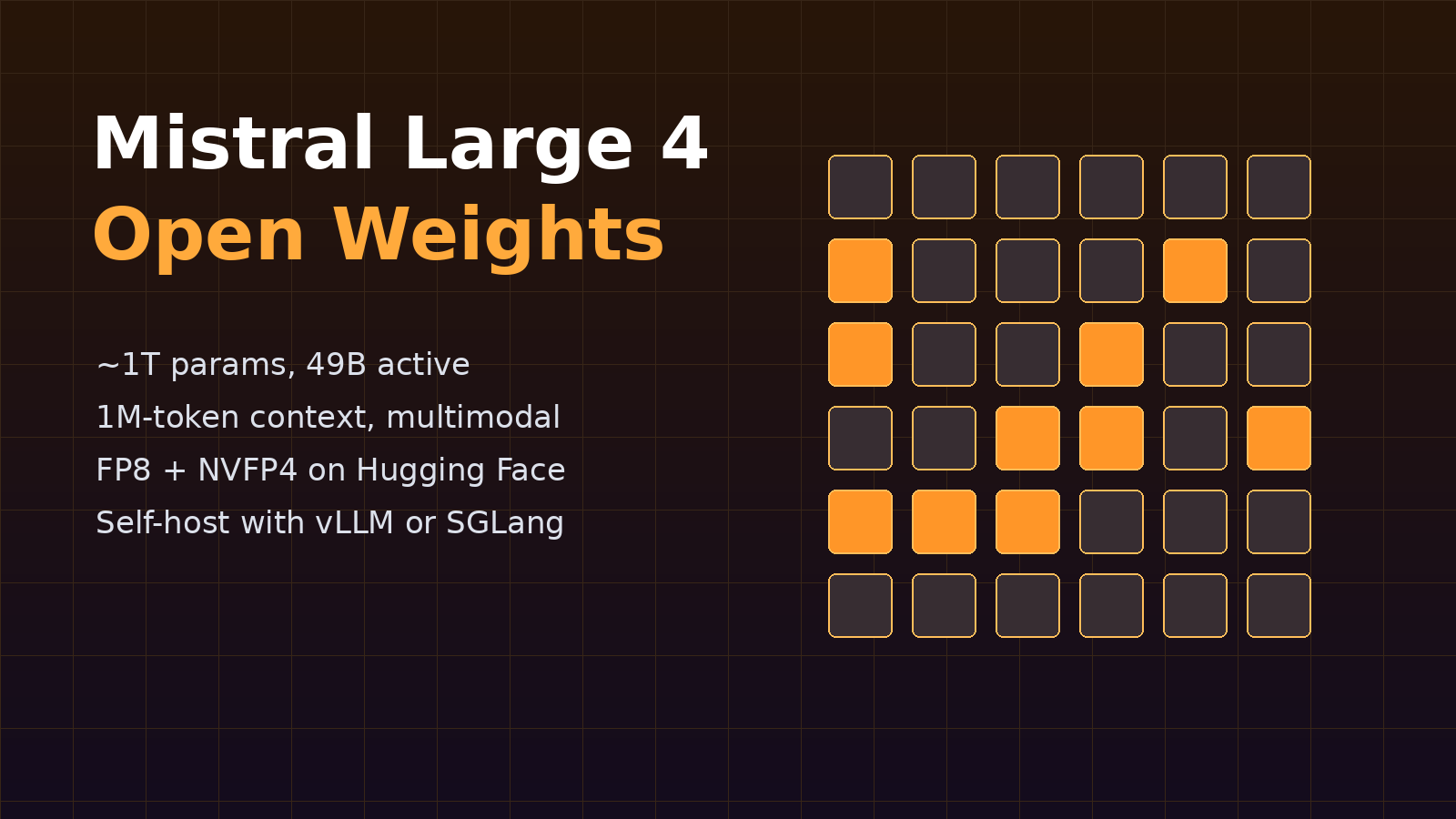
Open-weight AI just got a lot bigger. On October 29, 2026, Paris-based Mistral AI released the weights of Mistral Large 4, nicknamed “Le Chonk”, a natively multimodal Mixture-of-Experts model with roughly 1 trillion total parameters, 49 billion active per token, and a 1-million-token context window. Mistral calls it the best open-weight model for coding, it’s licensed for commercial use, and the checkpoints are on Hugging Face today in FP8 and NVFP4 flavors with day-zero support in vLLM, SGLang, transformers, and llama.cpp. For organizations that want frontier-class AI without sending data to someone else’s cloud, this is a big deal. Here’s what’s in the release, what it takes to run, and what the license actually allows.
The Release: From Preview to Open Weights in Three Weeks
The open-weight release is a meaningfully sharper model than Mistral’s earlier numbers suggested. According to The Next Web, its score climbed from 28% to 41% on Terminal-Bench 4.0, which tests agentic coding in a terminal, edging out GLM-5.3 at 40%. On Artificial Analysis’ Coding Agent Index, it rivals GLM-5.3 while using 47% fewer tokens per task on average.
Mistral says the model was trained from scratch on 3,800 NVIDIA Grace Blackwell GPUs in its own data centers in Europe, a point it leans on heavily for sovereign AI buyers.
What’s Under the Hood
According to the Hugging Face model card and Mistral’s announcement, the key specs are:
- Architecture: a sparse Mixture-of-Experts with about 1T total parameters and 49B active per token (52B including embeddings and output layers).
- Inputs and outputs: text and images in, text and code out, with native function calling and strict JSON schema output.
- Reasoning modes: reasoning effort configurable per request as low, medium, or high to trade cost against quality.
- Languages: support for 160+ languages.
- Speed tricks: an embedded DSpark speculative decoding draft head ships in the checkpoint.
What It Takes to Run It Yourself
This is not a laptop model. Hugging Face’s deployment recipe runs the FP8 weights with vLLM split across eight GPUs using tensor and expert parallelism. The NVFP4 checkpoint targets Blackwell hardware (B200, B300, GB200, GB300) and, per The Next Web, runs on four B200 or B300 GPUs.
- Self-hosted: download from Hugging Face and serve with vLLM or SGLang; llama.cpp is supported and GGUF quants are available from Unsloth.
- Managed: the Mistral API, OpenRouter, or an NVIDIA NIM container.
- API pricing: $0.70 per million input tokens, $0.07 cached input, and $2.10 per million output tokens.
- Customization: fine-tune on proprietary data through Mistral Forge or your own training stack.
The License Fine Print
Large 4 ships under the Mistral Ecosystem Open-Weight License, a modified MIT license. It’s free to use, modify, fine-tune, and commercialize, with a single condition: businesses that operate a Model-as-a-Service offering must get a separate commercial license from Mistral. For an enterprise running the model internally, that’s about as permissive as it gets. For an MSP thinking about reselling hosted inference to clients, it’s a line to read carefully before you build a product around it.
Why It Matters for IT Teams
Pierre Stock, Mistral’s VP of Science, framed the release as an independence play. As he told The Next Web, “AI is going to be like electricity,” and no company should depend on a provider that can cut off access “from one day to another.” That argument lands with regulated industries, public sector buyers, and anyone with data residency requirements. Open weights also mean you can pin a version, audit behavior, and keep running it regardless of a vendor’s roadmap.
The trade-off is responsibility. Self-hosting a trillion-parameter model means owning GPU capacity, patching the serving stack, securing the inference endpoint, and building your own guardrails. Provenance and supply-chain checks on model files belong in your security process.
Looking Ahead
Mistral says smaller, distilled versions are coming in the coming months, including one that runs on a laptop, though it hasn’t committed to dates. Those are the releases that will matter most to small and midsize shops that can’t justify a rack of Blackwell GPUs.
In the meantime, Large 4 raises the bar for what “open” means at the frontier. If your organization has been waiting for an open-weight model good enough for serious coding and security work that you can run on your own terms, the wait may be over, as long as you budget for the hardware.
Sources:
- Mistral AI, October 29, 2026
- Hugging Face, October 29, 2026
- The Next Web, October 29, 2026