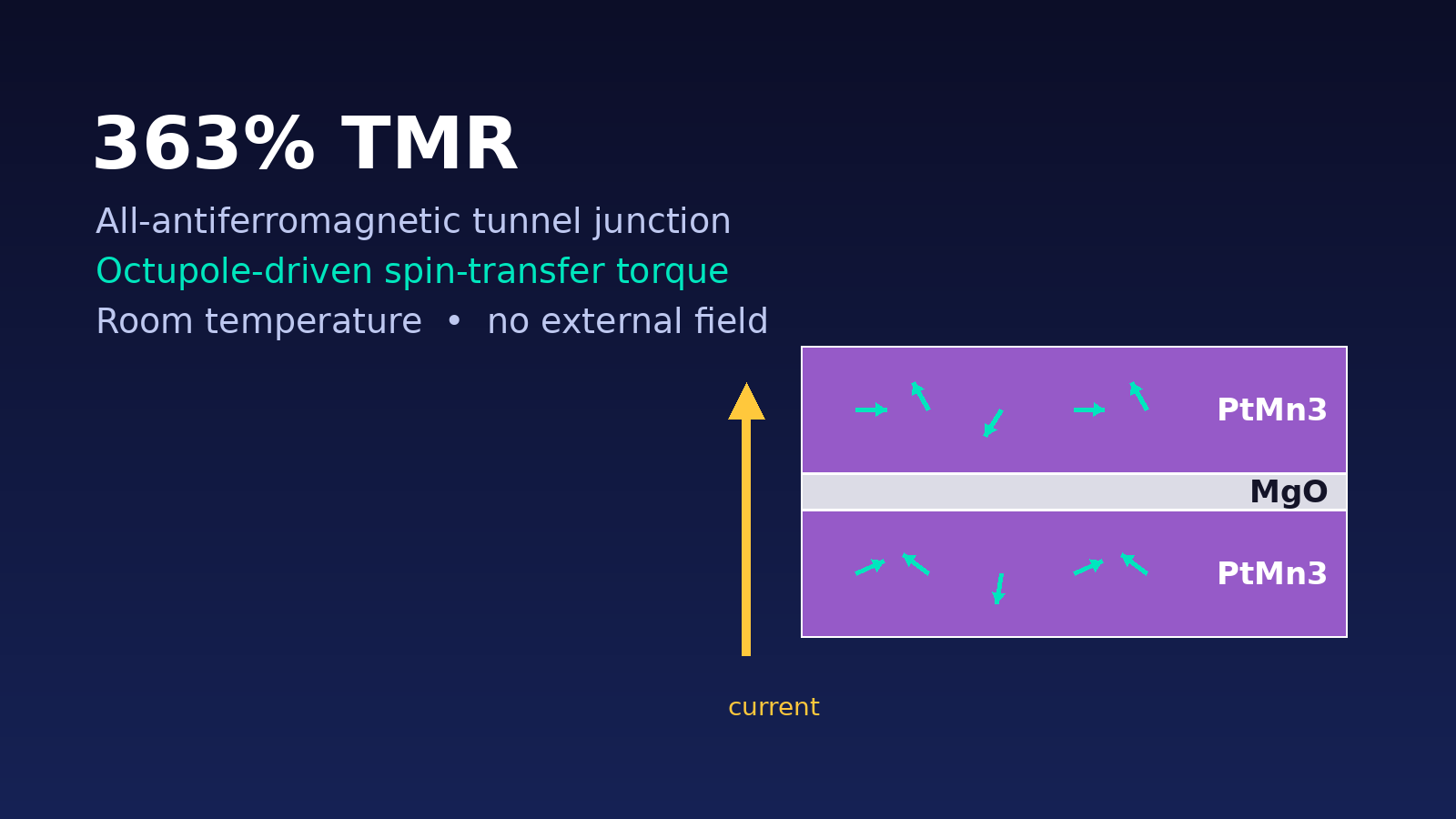
A team led by Northwestern University’s Pedram Khalili reported in Nature on October 21, 2026 that it has electrically written and read data in a magnetic memory cell built entirely from antiferromagnets, materials long thought to be nearly impossible to control with current. The researchers built nanoscale all-antiferromagnetic tunnel junctions (AATJs) from two layers of PtMn3 separated by a thin MgO barrier, and showed a room-temperature tunneling magnetoresistance (TMR) of 363% for reading, plus current-driven switching at densities on the order of 10 MA/cm² for writing, with no external magnetic field. The writing mechanism, which the team calls octupole-driven spin-transfer torque (OTT), had not even been predicted by theory. Here’s what was discovered, how it works and why it matters for the future of memory.
1. The Discovery: Spin Torque Where It Wasn’t Supposed to Exist
Today’s MRAM and the read heads in hard drives rely on ferromagnets such as iron, cobalt and nickel, in which electron spins line up the same way and produce a net north and south pole. Two effects make those devices work: tunneling magnetoresistance, which lets a circuit read the magnetic state as a change in resistance, and spin-transfer torque, which lets a current flip that state to write a bit.
Antiferromagnets are different. Neighboring spins point in opposing directions and cancel out, leaving no net magnetization. Because the current flowing through them is spin-neutral, the field assumed neither effect could be sizeable in an all-antiferromagnetic device. Earlier work had already shown TMR in junctions made from chiral antiferromagnets. The new paper delivers the missing half. As Khalili put it, “The conventional wisdom was that you should not have spin-transfer torque or giant or tunneling magnetoresistance with these sorts of materials. And this is basically what we show is not true.”
2. The Technology Behind It
The key is that PtMn3 is a noncollinear antiferromagnet, meaning its spins sit at angles to each other rather than simply up and down. That arrangement gives the material a cluster magnetic octupole moment, a more complex description of spin order than the simple dipole of a bar magnet. According to the paper, OTT arises from an imbalance between intra- and inter-sublattice spin currents across the junction, or equivalently from a non-zero net octupole polarization in each PtMn3 layer. Think of it as a crowd that looks perfectly balanced from the outside, yet still pushes in a consistent direction when it moves through a narrow doorway.
Key results from the paper and its preprint:
- Read signal: TMR of up to 363% at room temperature, which Khalili says is “as large as with ferromagnets.”
- Write current: bidirectional switching with a sharp transition near 11 MA/cm², without any external magnetic field.
- Device size: pillars from 50 to 200 nm in diameter switched at similar current densities.
- Stability: the team estimates the free layer’s energy barrier at roughly 39 kT, based on pulse-width-dependent switching measurements.
- Manufacturing angle: the films were deposited on a 150 mm silicon wafer, and the collaboration included Western Digital along with Cornell, Purdue, UT Austin, the University of Nebraska–Lincoln, the University of Messina and Politecnico di Bari.
The team also developed a new theoretical framework, backed by density functional theory calculations and micromagnetic simulations, to explain the effect. “We report the first experimental observation, but this torque was really something that had not even been theoretically predicted before,” Khalili said.
3. Why It Matters for IT
For anyone who manages hardware, the interest is in what antiferromagnetic memory could eventually fix:
- Immunity to stray fields: with no net magnetization, stored bits are far less vulnerable to nearby magnets. “If you store information in a ferromagnet, a large enough magnetic field nearby can destroy the information. None of that would happen with antiferromagnets,” Khalili said.
- Density: without stray fields between cells, the paper describes a pathway to “deeply scaled magnetic memory,” and Khalili points to higher-density, more reliable memory for AI workloads.
- Speed: ferromagnetic dynamics typically run at gigahertz frequencies, while antiferromagnetic dynamics can reach the terahertz range, opening doors for faster computing, communications and terahertz detectors.
With memory prices squeezing IT budgets and AI driving demand for denser, faster storage, any credible new memory platform is worth watching, even if it is years from a server rack.
4. Challenges Ahead
This is a lab demonstration, not a product. The work does not yet show terahertz operation, and the researchers have not announced a commercial timeline. Switching currents around 10 MA/cm² and integration with conventional CMOS logic still have to be proven out at scale, and the team says it next plans to test other noncollinear antiferromagnets to see whether they produce even stronger effects.
Looking Ahead
Khalili frames the result as foundational, comparing it to the discoveries of giant magnetoresistance, tunneling magnetoresistance and spin-transfer torque, which “opened a new field and set a whole community’s direction for 20 to 30 years.” Next steps include probing terahertz dynamics directly and exploring how AATJs can be combined with standard semiconductor electronics.
For IT pros, the takeaway is simple: the physics roadblock that kept antiferromagnets out of memory chips has just been knocked down. If the engineering follows, future MRAM could be denser, faster and shrug off magnetic interference, a welcome prospect for anyone who has watched memory costs and AI-driven demand climb.
Sources:
- Nature, October 21, 2026
- Northwestern Engineering (McCormick School of Engineering), October 21, 2026
- arXiv preprint 2509.03026, September 2025