Gartner used its IT Symposium/Xpo in Orlando on October 21, 2026 to drop a headline number that every IT budget owner will be quoting for the next year: worldwide IT spending is forecast to hit $7.35 trillion in 2027, up 15% from 2026, crossing the $7 trillion mark for the first time. The engine behind that growth is AI infrastructure and AI software, but the forecast carries a sting for anyone who buys hardware: memory prices have more than doubled over the past 12 months, and Gartner expects that “memflation” to persist through 2027. Pair that with a Gartner CIO survey released two days earlier showing that only 13% of CIOs say their enterprise has realized significant or transformational value from AI, and a clear picture emerges. Here’s what the numbers say and what they mean for the techs and MSPs who will be asked to do more with pricier gear next year.
The Forecast: AI Pushes IT Spending Past $7 Trillion
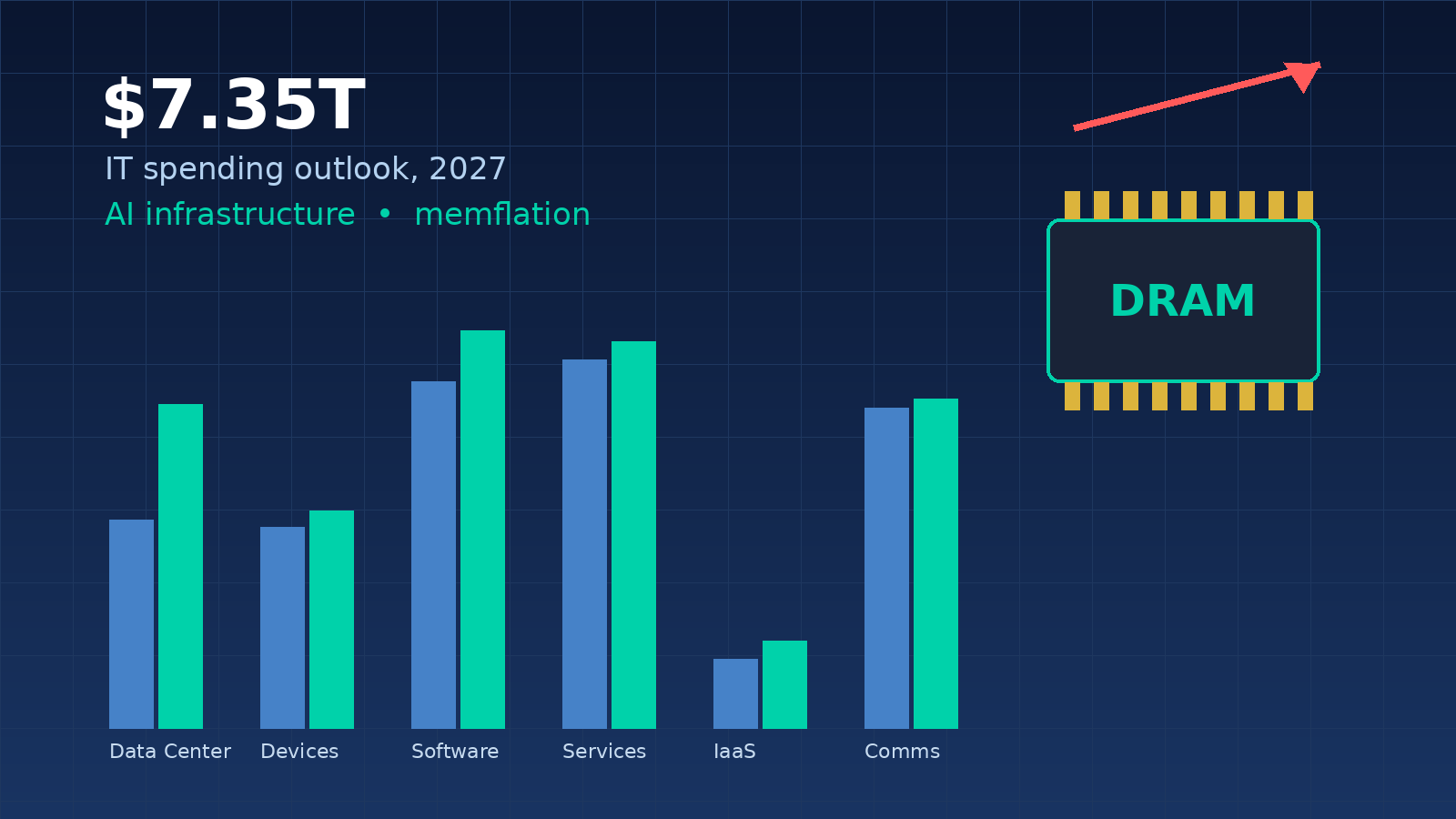
According to Gartner, the “next $1 trillion” in IT spending growth is being shaped by two interconnected domains: AI infrastructure and AI software. Spending on AI-optimized servers, AI-optimized infrastructure as a service (IaaS) and AI software platforms continues to strengthen as organizations try to industrialize AI deployment. Gartner’s segment-by-segment outlook for 2027 looks like this:
- Data center systems: $1.366 trillion, up 55.5%, the fastest-growing segment by a wide margin after a 73.8% jump in 2026
- Infrastructure as a service (IaaS): $367 billion, up 25.7%
- Software: $1.679 trillion, up 14.6%
- Devices: $916 billion, up 8.1%
- IT services: $1.633 trillion, up 4.9%
- Communications services: $1.391 trillion, up 2.9%
As Gartner Distinguished VP Analyst John-David Lovelock put it, “Collectively, the market forces are reinforcing spend around AI infrastructure, AI-enabled cloud platforms and advanced software ecosystems, as these are the most attractive opportunities in global IT spending.” Gartner also noted that infrastructure itself is increasingly being treated as a strategic investment asset, backed by hyperscaler capital expenditure, private capital and, in some cases, the technology suppliers themselves.
Memflation: Why Your Next Hardware Quote Will Sting
The less glamorous half of the forecast is the one that lands on a tech’s desk. Gartner says data center demand has driven memory prices to more than double in the past year, with increases cascading through storage, server, networking, PC and device supply chains. Think of it as the AI build-out drinking from the same well as your laptop refresh: when hyperscalers and AI cloud providers buy memory by the warehouse, everyone else pays more for what is left.
“This ‘memflation’ effect is expected to persist through 2027 before hardware pricing begins to stabilize,” Lovelock said, adding that higher average selling prices support spending growth while the pressure on affordability is expected to suppress end-user demand. Speaking to CIO Dive, he was blunter: “Everything that has a memory chip or a computer chip in it is going up in price and there’s no negotiating.” In other words, a meaningful slice of that 15% headline growth reflects higher prices, not more gear.
The AI Value Gap: Big Spend, Modest Returns
While spending surges, proof of payoff is lagging. Gartner’s 2027 CIO and Technology Executive Agenda survey, which polled more than 2,000 CIOs and technology executives, found that only 13% say their enterprise has realized significant or transformational value from AI so far. Gartner also reported that the likelihood of an AI use case succeeding remains roughly one in five.
“Volume is not value,” said Gartner VP Analyst Alicia Mullery. Gartner’s advice centers on discipline: define use-case value up front, and set clear rules for when a pilot should not go to production and when a low-value AI initiative already in production should be shut down. At the same event, Gartner analysts urged CIOs to balance AI value against AI risk rather than chasing adoption for its own sake.
Why It Matters for IT Pros and MSPs
For the people who actually spec, buy and run the hardware, these trends translate into practical pressure points:
- Refresh budgets: PC, server and storage refreshes planned for 2027 may need more money for the same specs. Locking in quotes early and revisiting RAM and SSD configurations can stretch budgets further.
- Client conversations: MSPs quoting hardware projects should expect price movement between proposal and purchase and set customer expectations accordingly.
- Cloud versus on-prem math: With IaaS spending forecast to grow 25.7%, the build-versus-rent calculation for AI and general workloads is shifting and worth re-running.
- AI cost governance: Gartner’s published predictions say that by 2028, 60% of Global 500 companies will embed AI FinOps controls at inference, and that by 2030, 80% of organizations with public-facing AI will have experienced a “cost exhaustion attack” designed to run up AI bills. Token usage is becoming both a budget line and a security signal.
- Proving value: With only 13% of CIOs reporting major AI returns, IT teams that can measure outcomes and kill weak pilots will be the ones that keep their AI budgets.
Looking Ahead
Gartner’s forecast paints 2027 as a year of record IT spending, but much of it is concentrated in AI data centers and cloud platforms, while everyone else faces higher prices for memory-heavy hardware. Lovelock told CIO Dive that today’s subsidized model and token pricing will not last either: “As much as CIOs are worried about the cost of AI today, it’s not going to be this low again.”
For techs and MSPs, the smart play is to plan for pricier hardware, scrutinize every AI project for measurable value, and treat AI consumption as something to monitor and govern like any other critical resource. The AI boom is real, but so is the bill, and 2027 is shaping up to be the year organizations find out which of their AI bets were worth it.
Sources:
- Gartner, October 21, 2026
- Gartner, October 19, 2026
- Gartner, September 15, 2026
- Business Wire, October 21, 2026
- CIO Dive, October 21, 2026
- Network World, October 22, 2026
- InformationWeek, October 19, 2026