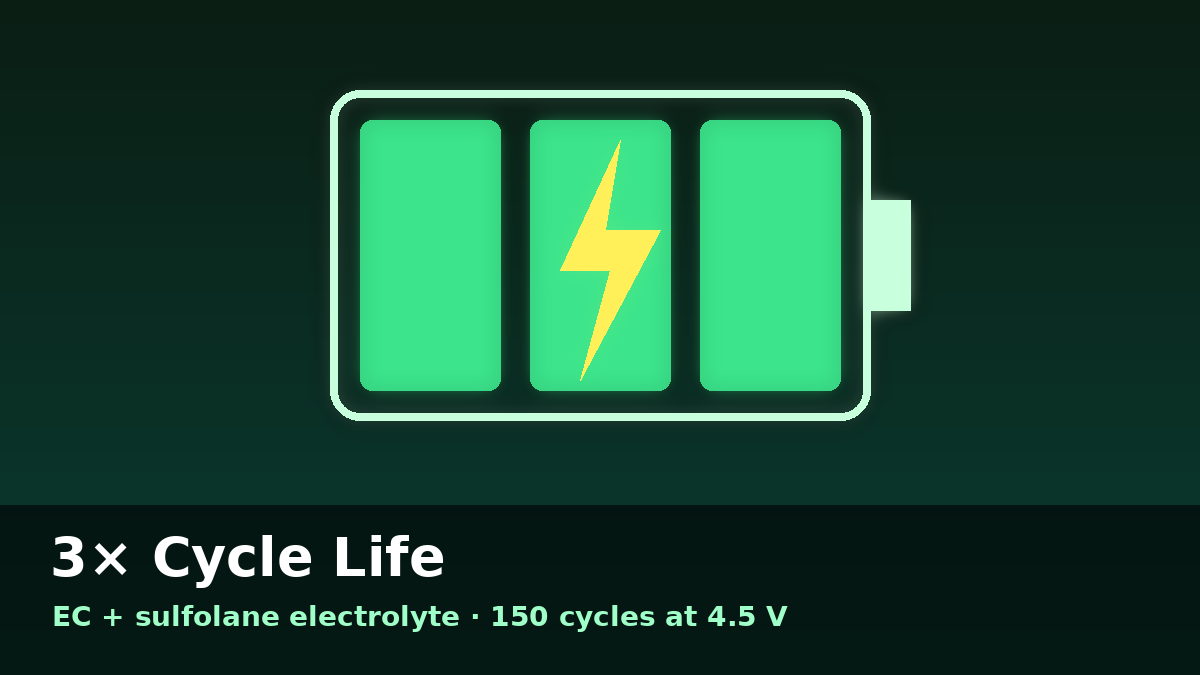
Korean researchers have developed an electrolyte that roughly triples the cycle life of high-voltage lithium metal batteries using nothing more exotic than two inexpensive, commercially available solvents. Announced on October 12, 2026 by a team led by Professor Song Hyun-kon of UNIST (Ulsan National Institute of Science and Technology) and Professor Seo Dong-hwa of KAIST, the electrolyte let a cell with a high-nickel NCM811 cathode keep about 80% of its capacity after 150 cycles at 4.5 volts, versus roughly 50 cycles for a conventional carbonate electrolyte. Here’s how two solvents that were each considered unsuitable ended up working together, and why it matters.
The Problem with Lithium Metal
Lithium metal anodes are a leading candidate for next-generation, high-energy batteries in electric vehicles and energy storage systems (ESS). But they degrade quickly, especially when charged to high voltages. Unstable reactions between the lithium surface and the electrolyte consume material, generate gas and grow the needle-like deposits known as dendrites that can short a cell. Many of the best-performing fixes rely on costly fluorinated solvents or high-concentration salt formulations.
The Chemistry: Cooperative Solvation
The team mixed ethylene carbonate (EC) and sulfolane at a 3:7 weight ratio, along with a lithium salt and a small amount of an additive that forms a protective film. Both solvents bind strongly to lithium ions and had previously been excluded from lithium metal battery designs for that reason. Combined, however, the attraction between the two solvents weakens their grip on the lithium ion, an effect the researchers describe as cooperative solvation. The result is more uniform lithium deposition and a more stable solid electrolyte interphase (SEI) on the anode. The work was published in ACS Nano.
The Numbers
- Cycle life: About 80% capacity retention after 150 cycles at 4.5 V and 25°C, compared with conventional carbonate electrolytes falling below 80% after about 50 cycles.
- Initial Coulombic efficiency: 98.24%.
- Average Coulombic efficiency: 99.35%.
- Side effects suppressed: Reduced gas generation from electrolyte decomposition and less nickel leaching from the cathode.
- Cost profile: No fluorinated solvents or high-concentration salts required.
“We improved electrolyte performance using only commercial solvents, without depending on fluorinated solvents or high-concentration salts,” Song said. “This should help extend the service life of high-capacity lithium metal batteries for use in energy storage systems (ESS) and electric vehicles.”
Why It Matters
Battery breakthroughs often stall on cost and manufacturability. This one stands out because it relies on chemicals the industry already produces at scale. For IT and infrastructure teams, the relevance is growing: lithium-based ESS and UPS systems are increasingly common in server rooms and datacenters, and higher energy density means more backup runtime in the same rack footprint.
It is important to keep perspective. 150 cycles is a major improvement for lithium metal at high voltage, but it is still far short of what commercial EV or ESS packs require, and the results come from lab-scale cells. Long-term durability, safety testing and scale-up will determine whether the approach leaves the lab.
Looking Ahead
The UNIST and KAIST work is a reminder that progress in batteries does not always require exotic new materials; sometimes it comes from understanding how familiar ones interact. By turning two “unsuitable” solvents into a cooperative pair, the team has opened a lower-cost path toward stabilizing lithium metal anodes.
If follow-up research can push cycle life further and prove the chemistry in larger cells, cheaper electrolytes like this one could help bring higher-capacity batteries to EVs, grid storage and, eventually, the backup power systems keeping our networks online.
Sources:
- Seoul Economic Daily, October 12, 2026
- DongA Science, October 2026
- The Asia Business Daily, October 12, 2026
- ACS Nano, 2026